


Chisholm Trail Museum to celebrate Hatcher Hospital Centennial


Dr. A.R. Hatcher is shown with his nurses in the day.
by Amber Schmitz, Sumner Newscow — With the belief that hospitals should be downtown to better serve people, Dr. A.R. Hatcher built the Hatcher Hospital across from the Sumner County Courthouse in 1916. The building now serves as the Chisholm Trail Museum.
In celebration of the hospital’s centennial, the museum brought the surgery room back to its glory and will have guided tours available to the public from 2 to 4 p.m. this Saturday. There is no admission charge, but donations are appreciated. There will be a guided tours from 2-4 p.m., refreshments, and drinks. People can visit any part of the museum, but the guided tours will cover the lobby, doctor’s office, nursery, and surgery room. The surgery room has been remodeled, and includes an exact replica of a surgery table that Dr. Hatcher used in 1919, among several surgical tools that were left when the hospital closed. The surgery room had pretty high standards for 1919.
The museum is open to the public with donations accepted.

The Hatcher Hospital would eventually become the Chisholm Trail Museum of today.
When Dr. Hatcher first moved to Wellington in 1910, he practiced at St. Luke’s Hospital, now Sumner Regional Medical Center, which was outside the city limits at the time. He began practicing medicine in Allen, Kans. in 1908.
Dr. Hatcher also believed that all medical services available should be provided to the public. The two story building consisted of three clinics, children’s clinic, a dentist, optometrist, bone specialist, even having one from Austria at one time, and the Meninger Clinic also provided mental health services there. He wanted a more excellent hospital and more advanced medical care available, so he and the Hatcher Hospital Association opened the Hatcher Hospital, and any doctor could practice there.
The modern, fireproof building was state of the art for that time and made for the safety of the patients. The building was constructed by J.H. Mitchell and Son and was the first of this type in Wellington. When constructed started in 1916, the hospital area was in the back, and the front was he and his family’s private living quarters. The hospital had two Wellington firsts, the first self operated elevator installed in the city, and the first electric dumbwaiter, in which prepared foods were able to be carried piping hot from the kitchen to the second floor. The facility also contained the most modern in sterilization with facilities for steam, water and dry sterilization.
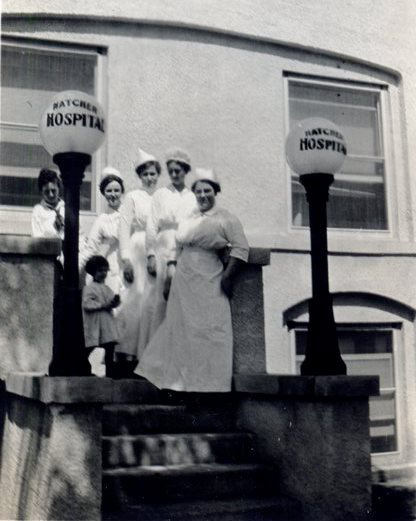
The Hatcher Hospital nurses.
Dr. Hatcher served in the Army Medical Corp. during World War I in 1918 at which time the hospital was closed. When he came back to Wellington, he wanted a larger, better surgery unit, which was on the second floor at that time. In 1919, he built a third story, which opened in 1920. The state of the art building also included a lobby area, offices, a pharmacy, full lab and x-ray area. The museum still has the x-ray machine on display.
Dr. Hatcher was one of the best known physicians and surgeons in the state, and even organized and was the first president of the State Hospital Association, which he was the oldest living member at the time of his death. He was also president of the Mid-West Hospital Association and a member of the American College of Surgeons.
After adding on a third floor, Dr. Hatcher purchased the house next door to the hospital, and his former living quarters in the hospital were turned into a lobby and offices.
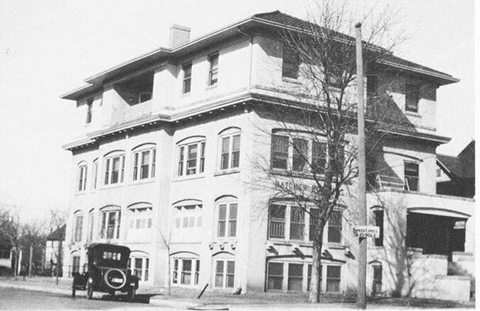
A third story was added.
In 1933, a nursery wing, delivery room, mother’s room and utility rooms were added. They were sound proof with all tile floors and no doors on the ward, so that the new mothers could have privacy.
During World War II, Dr. Hatcher didn’t feel that he and his staff were providing adequate medical care, so he closed the hospital. It re-opened in 1946 when the war ended.
A total of 11,950 patients were admitted to the Hatcher Hospital from Wellington and the surrounding area over the 48 years that it was in operation.
Dr. Hatcher retired from medical practice in 1941, and died in 1960. Dr. Hatcher’s son, A.C. Hatcher, was also a doctor and continued running the hospital until his passing in 1964. Dr. A.C. Hatcher was coming into the hospital to treat an emergency patient, and died of a heart attack right in the hospital.
In 1965, the Hatcher family generously donated the building to the Chisholm Trail Museum. Last year, the museum celebrated its 50th year in operation.
In celebration of the hospital’s centennial, come enjoy guided tours from 2-4 p.m., refreshments, and drinks. You can visit any part of the museum, but the guided tours will cover the lobby, doctor’s office, nursery, and surgery room. The surgery room has been remodeled, and includes an exact replica of a surgery table that Dr. Hatcher used in 1919, among several surgical tools that were left when the hospital closed. The surgery room had pretty high standards for 1919.
The museum is open to the public with donations accepted.


