Michelle Yipe: Women had an important and very tough role in U.S. Civil War
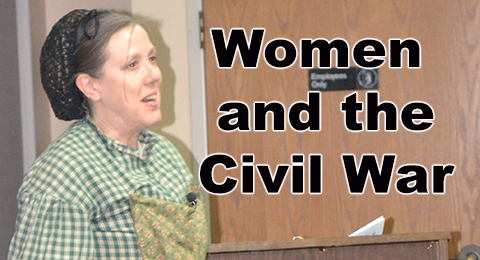
by Amber Schmitz, Sumner Newscow — Women played an important role in the Civil War, even dressing up as men and fighting as soldiers, some becoming sergeants and generals, although most of it was denied by the Army at one time.
During the Civil War, women were nurses, mascots who carried a drum, laundresses, ladies of the evening, and yes, these “delicate flowers” even hid their gender to fight as soldiers.
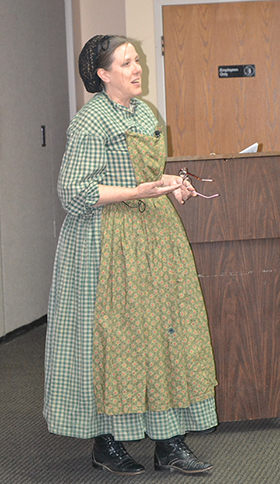
Michelle Yipe speaks at Historical Society meeting Monday.
Michelle Yipe of Argonia presented a program about the importance of women during the Civil War during the Sumner County Historical Society’s monthly meeting at the Good Taste Chinese restaurant to a crowd of about 20 women and four men Monday evening.
When Yipe’s father took her to Wilson’s Creek Battlefield in 1982, she fell in love, and began portraying Civil War characters, dressed in period clothing. She has attended re-enactments and portrayed some of the different women who played an important role during the Civil War. Characters she has been include: laundresses, camp followers, women who were visiting from the area town, nurses, a women in mourning who had just lost her husband, a “soiled dove,” and even a young boy soldier.
“I’ve always loved history, it was my favorite subject in school,” Yipe said.
Her father used to be a re-enactor, and she had grandfathers who fought in the Civil War.
“I fell in love with it, and I’ve been doing it ever since about 30 years,” she said.
Yipe said that women’s participation in the Civil War has been overlooked, and currently, it is being written into many history books.
Yipe was dressed in a working woman’s outfit from the Civil War period, which included a long dress, apron, bonnet, and corset.
“I love history, it’s like a mystery, you always learn more,” Yipe said.
During the Civil War era, women were considered “delicate flowers,” and the weaker sex, although put on a pedestal by men, who thought they needed to protect them.
Back east, textile mills and factories opened jobs for women, which made them independent, as they had their own money.
“They were making their own money, and men thought that women couldn’t handle what they could handle,” Yipe said.
Primarily textile mills employed women at this time, where uniforms and shoes were made. Mainly immigrant and low class women worked in mills. Some children even worked in mills, as they were small enough to fit through looms and fix equipment. Ammunition factories also employed women and children, although mill work was considered dangerous. A lot of times, garment factories would catch fire from lint, and ammunition factories would blow up, killing several women and children, as they were locked inside and couldn’t get out.
While the men were fighting the wars, the women who weren’t fighting, were left to attend to their plantations and farms. There were 48 percent of women in the north during this time period who were farmers, and 69 percent in the south. Besides working hard to support their families, women still had to come home and do the farm chores, which included cooking, sewing, sweeping, dipping candles, washing dishes, dusting, washing windows, plowing fields and cutting wood. Gardening was especially important, as that’s where they obtained their vegetables and spices to cook with.
The average annual income was $300 per year.
“There were lots of chores, and women worked really hard,” Yipe said. “A pregnant woman would work in the field up to the day her baby was born, then be right back in the field the next day.”
Women back then were expected to be married by age 18, or they were thought of as an “old maid,” considering the age 40 life expectancy.
Women also worked as motel attendants and sold whiskey.
Yipe said that a woman who decided to get a divorce, was shunned by her family, as it was unheard of in society at that time.
Nursing opened up as a new employment opportunity for women during the Civil War. Before this time, only men were allowed to be nurses. Women were very valuable during the war with at least 642,427 casualties, which includes those killed, injured, diseased and prisoners of war. Females bandaged wounds, made conditions sanitary and fed the soldiers using food rations.
Requirements for being a nurse on the battle fields included being over 30, not being pretty, and could handle seeing naked bodies and severed limbs.
Toward the end of the war, they allowed more women in, as they had so many wounded soldiers to care for.
“It became a really big thing,” Yipe said. “Women could get into the hospitals, and onto the battle fields before, during and after the battles.”
These women became known as the Sisters of Mercy, and worked very hard for little or no pay. Some women were paid as little as $12 a month.
“It was a very thankless job,” Yipe said.
The idea for women nurses, Yipe said, same from a war in England ten years prior. Some women would approach the Generals to get supplies for the men, and they listened to them, which was very unusual.
At first, female nurses would receive their training back east from Clara Barton, and the Army would follow her direction. Eventually, Generals put the nurses under the direction of the surgeons.
Women arrived at the military hospitals a day or so after the battles ended, and supplied many things for the men.
It was forbidden for women to fight as soldiers then, but records indicate that about 750 did.
“They would tape up their chests and dress as men, as the only medical exam was to have at least two teeth, no limp, and be able to walk for miles,” Yipe said.
Some women served for the adventure, while others wished to fight alongside their husbands. During this time, the military looked at women who wanted to join as lesbians or abnormal, and it was looked down upon. For years, the military denied that any women served, even though records indicate that they received pensions for their service.
“It took a lot of guts to be a woman soldier,” Yipe said. “They were surrounded by men, and if they were caught, they would be drummed out.”
The process of “drumming” someone out of the Army was a humiliating way of dishonorably discharging a soldier. A lot of times, a rope was placed around the soldiers neck, after his head had been shaved, and the smallest drummer boy would lead him out to the tune of “Rogue’s March” or “Yankee Doodle”. They would be forced to dress in felon’s clothes, and feathers were placed above their ears. Soldiers were drummed out for a variety of reasons, including thievery and desertion, or, being a woman.
A lot of women soldiers successfully hid their gender by bathing in streams alone, refusing medical treatment when wounded, and never taking their uniforms off in front of men. There is one story of an Army Sergeant whose soldiers thought “he” was just putting on weight during a winter encampment, and it turns out “she” was pregnant.
There is even a story about a female Colonel. Upon finding out their Colonel was a woman, the soldiers still respected her and served under her, as she was so good at being in charge. At Gettysburg, many women were in charge.
For safety reasons, most women traveled on supply trains. Female laundresses, women traveling with their husbands, or officers’ wives were allowed to ride the supply trains.
“Although laundresses did nothing most of the day, they still somehow had money,” Yipe said.
In the early days of the war, a woman was oftentimes adopted to be a mascot to carry a flag or drum, and would leave when the battle started.
“One lady, Albert D. Cashier, portrayed a man her entire life,” Yipe said. “It wasn’t discovered that she was actually a woman until she was stripped down for bathing in a nursing home.”
Women also served as spies for the other side, and smugglers.
“No one was going to search a woman, as it was hands off,” Yipe said.
Many medical supplies were smuggled in under women’s petticoats, especially in the south because of the blockade. Some were spies and collected information to send to the other side.
Most women barely had two or three petticoats, or wore nothing under their dresses, as they couldn’t afford them.
One female, who was a Union spy, was on the gallows, and the Union Army freed the town just one hour before she was to be hanged.
The “soiled doves” or “ladies of the evening” also played a major role in history. The term “hooker” comes from a man named General Hooker who was known for loving the ladies. When the soiled doves would walk into an encampment, soldiers would say “those are Hookers’,” meaning those are General Hooker’s ladies of the evening. He also believed in not denying his soldiers the same pleasures.
Many women lost their husbands as casualties to war, and were expected to be in mourning for at least three years. Society expected them to dress all in black, but each year, their veil could be shortened a bit. By the third year, they could wear white or lavendar, and then could eventually remarry. Many soldiers pleaded with the women to not wear all black, as it looked dreary. When men were in mourning, they were just expected to wear a black band around their wrist, and could remarry within six months of losing their wives.
Sanitary Fairs were held to raise money for supplies for the soldiers, as the government didn’t have a budget for the military during the Civil War. Women made and sold items to make socks, bandages, etc. for the sanitary commissions that visited the camps and supplied personal hygiene products to the soldiers. One fair raised over $1 million, which would compare to today’s war expenses of $383 million.
Yipe has been a Civil War re-enactor for over years, and attends about three events per year. While at events, she camps at the site and sleeps on her rope bed. The expression “sleep tight” she said, comes from the fact that you had to tighten the ropes on your bed or you wouldn’t sleep well.
“It’s really fun showing children the things in my tent,” Yipe said.
She plans on attending an upcoming Civil War event to be held in Fort Scott.