


State Representative District #80 Candidates Forum – Anita Judd-Jenkins and Michelle Schiltz

by Tracy McCue, Sumner Newscow — The following is a candidates forum featuring Anita Judd-Jenkins, a Republican, and Michelle Schiltz, a Democrat, who are running for State Representative of District #80 which encompasses the southern portion of Sumner County and the east half of the city of Wellington. The district is outlined in blue in the graphics below.
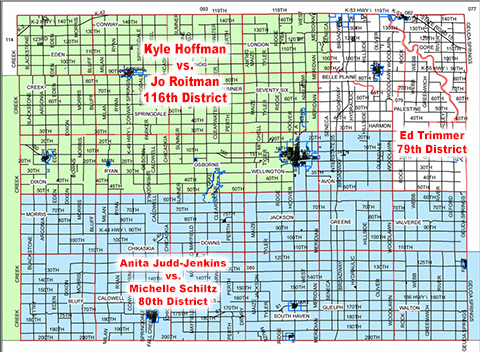 Click here for larger version.
 Click here for larger version.
 1. Briefly, tell us about yourself, your background, and how you became a candidate for the Kansas House/Senate in 2016?Â
Judd-Jenkins — I was raised and educated in Kirksville, Mo. and attended hometown Northeast Missouri State University (now Truman University). We moved to Arkansas City in 1976. I was widowed in 1981 with two young sons, and married Ronnie Jenkins in 1990. My eldest son lives in Winfield and teaches at USD 470. My youngest son died at age 25 in 2003. Both graduated from Southwestern College. I have a wonderful daughter-in-law (from Wellington) and grandsons, ages 13 -20.    Â
I retired in 2013 from a career in marketing and sales management. I worked as a Montgomery Ward store manager, John Morrell Processed Meats National Product Sales Manager, and the last 25+ years as the Marketing Vice President for Home National Bank (now RCB Bank) and Heritage Club Director, a loyalty program.
I have served as: Rotary past president, Soroptimists, Chamber of Commerce, Arkansas City Boards (Transportation, Tourism, Historical, Library), Twin Rivers Developmental Services Board of Directors, Junior Service League, 1st Presbyterian Church Deacon, advisory board for Presbyterian Manors. Past member of Kansas State Tourism Association and served on Advisory Board for Heritage Clubs International.
I had been approached for some time to consider running for Representative from professionals who felt I had the job skills that would serve our district well. I resisted until my eldest grandson expressed his concerns of staying in Kansas after graduating from college, saying his generation has only seen the diminishing of services and a state indebtedness that will affect his income and opportunities in his career. He accused my generation, and his parents’ generation, of apathy in the diminishing of our states strengths.
Schiltz — I am Michelle Schiltz, and I was born and raised in Caldwell, where I live with my husband Leo. After graduating from CHS, I attended Emporia State University, where I received a Master’s degree in history in 1980. I have owned two small businesses.  I am currently the President of the Caldwell Chamber of Commerce, and I served for 10 years on the Caldwell City Commission as Finance Commissioner, during which time my chief responsibility was the city budget. Â
I decided to run for the Kansas House because I truly believe that Gov. Brownback and his allies in the legislature have, through their irresponsible policies concerning taxation and school finance, as well as their refusal to expand Medicaid, damaged our state and hurt some of our most vulnerable citizens.
 2. Would you vote to repeal the Kansas income tax cuts of 2012? Â
Judd-Jenkins — Yes and no. Repealing the 2012 tax cut will not fill the hole that has been created, although it’s a start. We must develop a comprehensive tax plan that has everyone’s skin in the game while being mindful of our necessity for growth.
Schiltz — I would definitely look to repeal most, if not all, of the 2012 tax cuts. I would also close the LLC loophole, in which 330,000 people and businesses were exempted from paying any income tax.
 3. Revenues continue to fall short of projections for the state of Kansas. In turn Moody’s has reduced Kansas’ revenue bond rating for two consecutive years. How would you solve this issue?Â
Judd-Jenkins — Our lack of revenue, our debt, our lack of reserves, and our inability of pay our yearly obligations has created our poor ratings. To improve ratings this must be reversed by having a proper tax plan and fee structure to insure revenue growth and our ability to meet our obligations.
Schiltz — Clearly we cannot meet our revenue projections because the cuts to our revenue stream were too severe. We must develop a more responsible taxation policy in order to generate revenues so we can pay our bills. We cannot continue to borrow our way out of this budget crisis.
4. In a recent study conducted by Truth in Accounting – a Chicago-based research organization- it found that Kansas has the third-highest taxpayer burden in the Midwest. The firm attributes Kansas’ accumulation of long-term liabilities as a reason for this. How should Kansas solve this issue?
Judd-Jenkins — It’s a hard reality, we let it happen to our state, and now we must face the music. The governors and the legislators have not wanted to limit services, increase taxes, close tax loopholes, and realign tax exemptions to pay our full obligations. It’s not popular with constituents so it becomes hard to get reelected.
But with the Piper at our door for payment, we must do as any family in peril; leave our Party coats, egos, and personal agendas at the door, come together allowing everyone’s’ ideas to be studied and considered, prepare the best possible plan for recovery, implement what is needed, and share the process with family members so they may fully understand the reasoning of decisions.
Kansans are smart, realistic, and have historically pitched in during crisis to overcome adversity IF they are informed with plain talk and honest facts. Let’s stop the political spins, the distraction of prioritizing social agendas, and return to the business of financing our responsibilities.
Schiltz — In order to try to increase our revenues, the Brownback-led legislature passed the highest tax increase in Kansas history, all while claiming that they had reduced taxes. All they did was increase the burden of taxes onto the shoulders of the poor and middle classes, while giving the wealthy a break. Taking out “payday loans†to cover our deficits has dug us even deeper into our budget crisis.
We must create a fair taxation policy, in which everyone pays their fair share.
5. According to Sumner Regional Medical Center officials, the hospital is losing almost $600,000 to $750,000 a year by Kansas not participating in the federal Medicaid Expansion program. Do you believe Kansas should participate in such expansion?
Judd-Jenkins — YES, and for many more reasons than just our state’s hospitals finances. You may not like it, but if you pay any federal income tax, you are paying for Medicaid, in Kansas called KanCare. Thus far Kansas has just refused to take our share of the reimbursement of medical dollars, so it is distributed to those states who have accepted the federal plan.
Our medical providers, clinics, pharmacies, nursing homes, medical suppliers and auxiliary companies are in jeopardy when we underfund these expenses by inadequate reimbursement. The thousands of Kansas healthcare workers and support staffers and facilities are affected by this lack of funding. We are limiting any opportunity for stability and growth in the medical industry.
Schiltz — I firmly believe that Kansas should expand KanCare. Kansas does not save money by refusing expansion—it gives up the opportunity to bring tax dollars back to our state. Nearly all the costs of expansion are covered by the federal government through tax dollars we have already paid. Rural hospitals are in danger—which leaves rural Kansans without the healthcare we deserve.
According to the Kansas Health Association, Sumner Regional Medical Center has lost $766,253 in the past three years because of our governor’s refusal to expand Medicaid. Those who would be covered would be working Kansans who make too much to qualify for KanCare, but not enough to enter one of the exchanges, or who are not provided with insurance by their jobs.  Expanding Medicaid will help the Kansas economy and is estimated to create more than 3,800 jobs.
6. There is a lot of talk about restructuring the school funding formula. Do you believe a new school-finance system should be in place, or do you believe the state should return to the old formula that was in use as late as 2014?Â
Judd-Jenkins — I look forward to the rigorous process of the required new school formula in 2017. There are many who have been preparing new approaches as well as reformulating/revising the old school-finance formula. As a new legislator I plan to study these offerings while they are being discussed in committee and communicate with all our USDs superintendents to fully understand the implications of the proposed formulas. With their valuable knowledge I will be better prepared to vote accordingly.
Schiltz — The school funding formula that was in use in 2014 needs to be restored. Brownback replaced it with one that was neither fair nor adequate, and, as it turned out, unconstitutional. We need to return to the previous formula, and look at ways we can improve on it.
7. What is the No. 1 economic development issue for Sumner County and the state of Kansas today?Â
Judd-Jenkins — Sumner County has a unique opportunity this election cycle to propel its growth potential for decades to come. Cowley College is proposing a campus in Wellington to provide unique educational opportunities designed for Sumner’s industries and the retention of their youth.Â
Classes in agriculture business, aerospace engineering, technology, non-destructive testing as well as general education for those preparing for a 4 year degree will be provided to the county if the citizens realize this investment by supporting the ½ cent sales tax for 10 years. Besides the college itself being a new business in Sumner, it will provide an educated workforce for the growth of all Sumner industries. As a resident of Arkansas City, I invite Sumner County residents to visit our campus and see our growth in the last 25+ years!
Economic Development is a unique application of ideas, incentives, and cooperation shared between the state, county and city governments to find new industry opportunities as well as help sustain and provide growth opportunities for existing industry. All three factions of the government must be willing to fund it with their budgets and have creative, realistic incentives.
Current budgets have limited these opportunities. I would like the state to review the incentive programs to insure their effectiveness and determine new, creative approaches.
Schiltz — Kansas needs jobs. Sumner County needs jobs. Our population in Sumner County is shrinking, and along with it our tax base. We need to invest in ways to create new growth in both population and jobs. The 2012 tax cuts did not result in the “shot of adrenaline†that our governor promised.
Many thousands of jobs were lost in construction alone because of the cuts to transportation projects. Investment in infrastructure creates jobs. In Sumner County I believe we need to invest in our future by supporting the proposed expansion of Cowley College into Wellington.Â
 8. What is the best way to attract new jobs and visitors to Kansas?Â
Judd-Jenkins —Good healthcare, good schools, good infrastructure, educated workforce, favorable incentives, fair taxation, and cultural opportunities.
 Tourism generally comes to states that aggressively fund tourism and the arts. Success is attainable through budgeting for a creative master theme, state funding for theatre, museums, historic sites, state parks, etc., hospitality education plans for front line personnel (restaurants, hotels, museums, welcome centers, etc.), and a well-funded  creative marketing plan to publicize these efforts. Kansas has severely cut or eliminated funding in these areas.
Schiltz — We need to provide opportunities for our people here. We can keep our kids here in Sumner County by providing them with affordable education opportunities. We need to partner with our schools and businesses to help them educate our children to be innovators. Kansas spends next to nothing on tourism. We need to advertise our quality of life here in Kansas.  Our children are our future, and we must find ways to ensure that they get quality education and opportunities here at home.
9. Legalizing Marijuana has become a hot topic across the U.S. Do you believe that marijuana should be legalized in Kansas whether it be medical or recreational? How about the decriminalization or reduce sentencing of the drug?Â
Judd-Jenkins — I wish to be better informed by our criminal and judicial authorities before making a decision on the issue of decriminalization or reduced sentencing for marijuana. I also wish to learn from our medical professionals of the attributes of use for medical reasons as well as from economists on the tax benefits of decriminalization. If I am selected to represent District 80, it will be my responsibility to have an open mind and learn as much as possible on all issues facing our state. I must vote to the benefit of those I serve, even if I have no prior opinion or personal knowledge. Schiltz — I believe in legalizing medical use of marijuana, and I also believe in reduced sentencing. I believe it would free up our already bogged down court system so they can prosecute the more serious criminal cases effectively.
  10. Do you believe Supreme Court justices should be appointed by an independent judiciary council or should it be made by the governor?Â
Judd-Jenkins —An independent judiciary council. Our Founding Fathers designed our government to have 3 equal branches to ensure independence, fairness in representation, and freedom from tyranny. The governor is elected to lead the executive branch, not the legislative or judicial. To allow this governor or any future governor, to determine the makeup or balance of influence in the judicial or legislative branches undermines the very strength of our “separate but equal†system of government.
Schiltz — Our Supreme Court Justices should NOT be appointed by the governor. The judiciary branch needs to be chosen on merit. Our court system needs to be fair and free from any political influence.
11. What is your No. 1 pet peeve at the moment when it comes to Kansas state politics?Â
Judd-Jenkins — Partisanship.
Schiltz — My pet peeve about our state politics is that we are far too focused on political parties.  Personally I think that a lot of people out there lean much more towards being independent than being Republican or Democrat, and what policies they support or do not support. I am a Democrat, but that being said, it does not mean that I must fully support everything the party does. We must realize that compromise is the only way things get done—and I am willing to compromise in order to move Kansas, and Sumner County, ahead.
12. What would be the No. 1 question you would ask your opponent?
Judd-Jenkins — If I am the fortunate one to win in November, will you continue your active involvement by advising me on the issues in our District so I can better represent us?
Schiltz — Actually, Anita and I have become very good friends during this election cycle. Even though we represent different parties, we have discussed the issues and have found that we agree on much more than we disagree on—if anything! I would probably ask her where she would like to go out to dinner to celebrate when the election is over!
13. Do you have anything else to add?Â
Judd-Jenkins — I wish to thank the constituents in District 80 for their kind welcome. It has been my delight and pleasure to get to know many, and I look forward to meeting many more during the next weeks and months. I am a servant leader with experience in effective interaction with all social and economic factions. I will show up for work, attend the work sessions, and stay for the vote. I will seek the knowledge and advice of our District’s constituents in understanding the issues and how pending bills will affect our District. I seek to restore civil discourse while upholding our constitutional duty. My vote on every issue must be earned.
Schiltz — I chose to run for House District 80 because I feel our state is headed in the wrong direction. I also want to make sure that Sumner County gets the representation we deserve. Rural Kansas is hurting, and I hope that when I am elected, I will be able work on policies that will benefit our largely rural district—policies affecting our schools, our hospitals, our economy, and our farmers. We need new leadership in Topeka—and I humbly ask for your vote so I can fight for Kansas and Sumner County.
———
EDITOR’S NOTE: We will be featuring state representative candidate’s forums throughout involving Sumner County candidates. For the State Senate District 32 forum between Larry Alley and Don Shimkus click here.


