When Wichita students started a movement that changed history
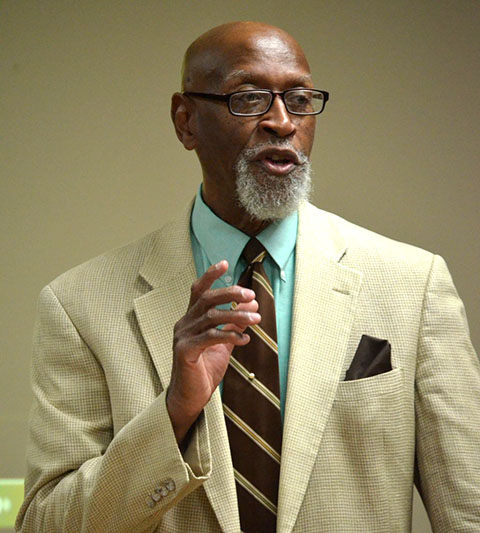
Dr. Galyn Vesey speaks at Sumner County Historical Society Saturday.
by Amber Schmitz, Sumner Newscow —  The Dockum Drug Store sit-in held during the summer of 1958 changed history for Wichita, the state of Kansas, the nation, and African American people. It was the first student-led lunch counter sit-in, using a peaceful protest to in efforts to end segregation.
One of the young men involved in the sit-in, Dr. Galyn Vesey, was the guest speaker at the Sumner County Historical Society meeting Saturday held at Good Taste Chinese restaurant. He showed a video of the history of the Dockum Drug Store sit-in, with interviews from several people, including those directly involved.
“This (video) makes an emphasis on black people, and what we had to deal with,” said Vesey, who is the project director of researching Black Wichita.
Vesey told the group that several white Wichita State University students were invited to join in the sit-in, and several did help. He used to go down there on Saturday morning and sit at the lunch counter, peacefully waiting to be served. At this time, Vesey was a 21-year-old Wichita State University student, and a member of the Young Adult Chapter of the NAACP (National Association for the Advancement of Colored People).
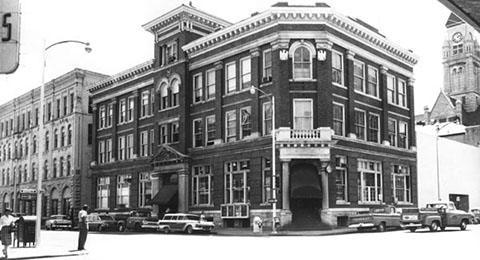
Dockum Drug Store in Wichita.
In 1958, African Americans were not allowed to be served at Dockum Drug Store’s lunch counter in Wichita. Those wishing to order food, were made to stand at the end of the counter and take it to go. During this time, those establishments who did serve African Americans, made them stand to eat their lunch. There were signs stating “White Waiting Room Only” in many establishments.
Wichita was very segregated during this time, and African American children weren’t even allowed to swim in the municipal pool, and were only allowed to skate on certain nights.
Until 1952, African American children could not attend school with white children, and were made to go to black only schools. It wasn’t until the Brown vs. the Board of Education court case in 1954, which forced Kansas to integrate their schools, that African American children were allowed to attend school with white children. Although they were forced to allow them, many of the old sentiments still remained.
When African American children were integrated into the schools, many were still treated unfairly, even receiving grades lower than they should have been given, according to the video. Although they were allowed to join the school sports teams after the integration, they were not allowed to stay in hotels when traveling, and had to make accommodations with local preachers.

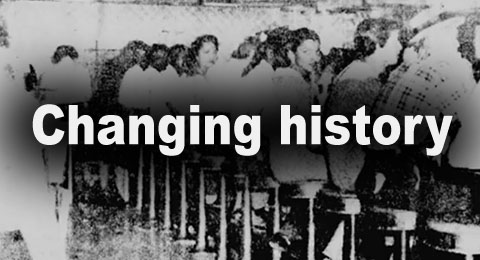
This Dockum Drug Store picture was published by the Wichita Eagle after it was told initially not to cover the event.
Ronald Walters, a youth destined for business at a young age, was the president of the youth NAACP group in Wichita. Tired of being treated differently than white customers, Walters and Carol Parks-Haun decided to organize a sit-in at Dockum Drug Store to try and put and end to segregation.
Preparation for the sit-in began in 1957, including discussing all of the possible scenarios that could take place. Many months of meetings were held at Parks’ home regarding the sit-in. During this time, there was violence toward African Americans all over the country, including beatings and deaths. Vesey said it took a lot of courage to be involved in the sit-in, as you never knew what could happen.
“We knew what the potential was, you had to have some anxiety,” Vesey said.
Chester Lewis, a state and national leader in the Civil Rights movement, was outraged by the city of Wichita’s segregation and filed a law suit against the city for having a segregated swimming pool. Lewis graduated from Hutchinson High School, served in World War II, and obtained his law degree from the University of Kansas. He led the Wichita NAACP and volunteered his expertise in law to the group.
The national NAACP contacted the group stating that sit-ins were not a NAACP tactic, and if student-led, there would be liability, as they were putting children in the front line. The national office warned them not to do it, but Lewis approved it and told the group he would be there if they needed him.
The group planned to enter the drug store one-by-one and sit at the counter waiting to be served, beginning with Parks-Haun. Initially, a waitress took her order and served her a Coke. But then others began coming in, and when the waitress found out the store policy was to not allow African-Americans at the front counter, her attitude changed and she told them she could not serve them.
All of the students were dressed in their Sunday best, were well disciplined and were very structured during the sit-in. They behaved respectfully, yet kept the seriousness of wanting to be served at the lunch counter. Every 30 minutes, the students would switch shifts, always keeping the counter full.
Eventually, they closed the counter, because white patrons refused to sit next to the African American patrons. According to the video, police came and stood behind them with clubs, so Lewis told them to leave quietly.
Police were ordered to keep their hands out of it, and the only media attention was in African American newspapers with a select few television interviews. The Wichita Eagle was told not to cover it.
“When sitting at Dockum’s, we took turns eating at a cafeteria,” Vesey said. “When I was about to eat my raisin pie, some of the group came and told me that there were some white youth on scene and that I needed to get back, so I didn’t get to eat my raisin pie.”
Vesey and the others took the back entrance into Dockum’s and when they got off the escalator, white youth bumped into their shoulders purposely.
“That was the one time we got close to trouble,” Vesey said.
Three weeks later, the New Hope Church was filled to capacity, and the students took their seats at the counter the following day during business hours.
After three weeks of the sit-in, Dockum himself approached his store manager and told him to serve them, as he was losing too much business.
“I recall a tall, white gentleman coming in and talking to an employee, and made the comment about taking down the placards, which we did,” Vesey said. “I told the manager we were not there to cause problems.”
Following this, all Rexall drug stores in Kansas became desegregated, then it became nationwide. The small Wichita sit-in was a monumental event, as it caused the business to change its policy, and it gained national attention.
After this, there were sit-ins held in Winfield and Oklahoma City, as well as other places, which caused other establishments to desegregate.
In 1960, the NAACP invited the Wichita group to a national convention, but none of the students were able to attend. There was very little recognition received and Dockum was not recognized as the first lunch counter sit-in.
During the summer of 2008, nearly 60 years after the courageous event, the Dockum Drug Store sit-in was recognized as the official sit-in of the Civil Rights Movement. Carl Brewer, Wichita’s mayor at that time, gave each member involved in the sit-in an official key to the City of Wichita, and agreed their recognition was long overdue.
“There is only one race, not all black or all white, God knew what he was doing,” Vesey said.
Vesey holds a Ph.D. in Social Science, earned in 1994 from the Maxwell School of Citizenship and Public Affairs. In 1961, he earned his Bachelor of Arts degree in psychology from Wichita State University, and his MSW from the University of Oklahoma in 1970.
Vesey became the Associate Professor and Director of Undergraduate Program Social Work Education from 1972-1985 at Utica College. He retired from teaching at Alabama A&M University in 2004, where he was Associate Professor and worked in policy, planning and administration. From 2008-2009, he was the Adjunct Instructor, where he worked on social work policy, at Bethel College.
‘